

Advances in Assessing and Addressing Mental Health-Related Safety in Sports
Sports Psychiatry
By: Dr. Carla Edwards, Sports Psychiatrist
Adapted from: Edwards C and Weatherbee P. Advances in Psychiatry and Behavioural Health, 2026 (full text of article available upon request)
Athletes of all ages and levels can experience mental health symptoms and disorders at any time. These experiences can be isolated, recurrent, episodic, continuous or chronic and may align with any position on the mental health continuum.
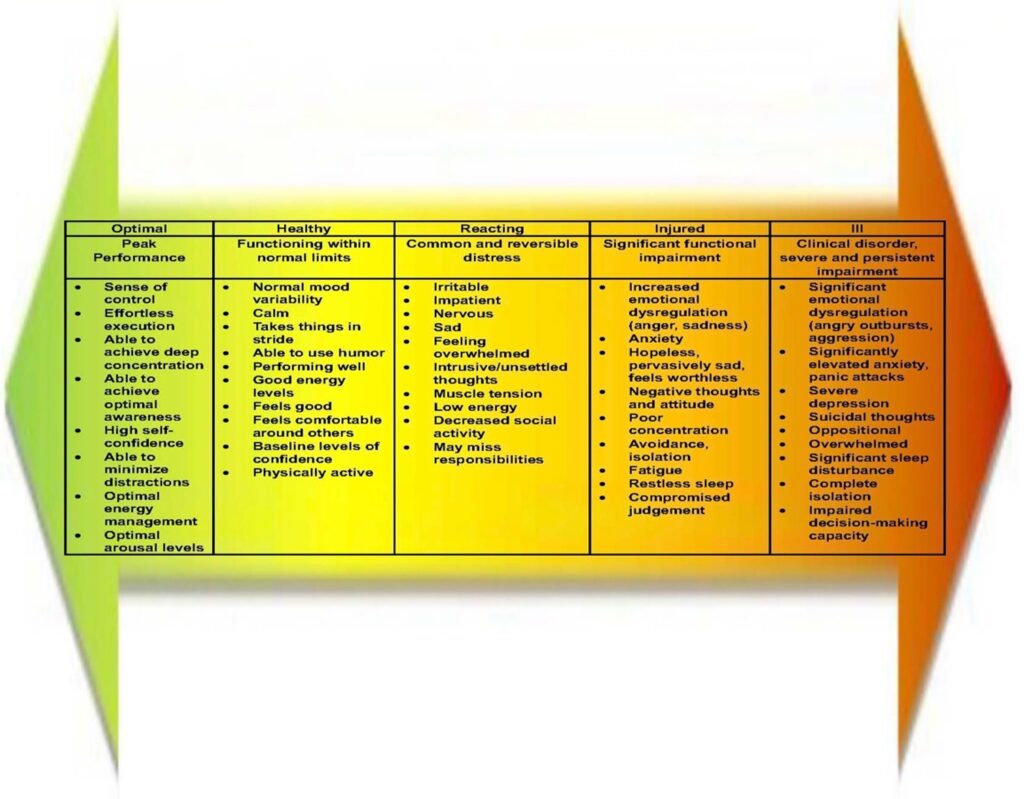
Mental health-related safety involves the influence of cognitive, emotional, and behavioral elements on the risk of physical or psychological harm to self or others. In sport, this applies to the impact of mental health factors on the athlete themselves, with consideration of the reciprocal interactions with the athlete’s sport ecosystem. The ecological model of sport, described by Professor Rosemary Purcell in 2019, explores the athlete’s microsystem, exosystem, and macrosystem. The athlete ecosystem is further defined as:
- Microsystem: including teammates, roommates, friends, family, partners, coaches, team staff, sport medicine staff
- Exosystem: the sport, structure, regulations and governing body
- Macrosystem: high performance environment, public and social media
Athletes are incredibly resilient individuals and can continue to participate in sport for an extended period despite the presence of mental health symptoms and disorders. When mental health symptoms or disorders are experienced more acutely, there may be occasions when the treating team needs to decide if it is in the best interest of the athlete to be removed from the sport environment for treatment and recovery. (Edwards, 2023) While sport interruption due to primary physical causes may be intuitive, mental health symptoms and disorders can interfere with function in ways that are poorly understood or recognized by non-mental health professionals.
When Mental Health Interferes
Removal-from-sport (RFS) and return-to-sport (RTS) decisions involving an athlete who has experienced mental health challenges can be complex. Guiding an athlete back to sport during or following an episode of mental health challenges does not always follow a linear path and can be associated with specific considerations.
Having a diagnosis alone does not preclude sport participation; however, symptoms and disorders that compromise safety, stability, and function may result in the athlete either having to modify sport participation under medical (including psychiatric) monitoring or being removed from sport participation until such a time that they are deemed suitable to return.
Removal from sport and return to sport decision-making and planning should include multidisciplinary collaboration and monitoring, with careful consideration of the athlete’s overall symptom load and assessment according to a framework of safety, stability, and function.
All professionals working with athletes should possess the knowledge and skills to assess risk factors and identify pertinent safety concerns.
Risk
Risk is defined as the likelihood of harm or adverse health outcomes, which can be stratified into low, moderate, and high. In a recent paper, CASEM Psychiatrists Carla Edwards and Pam Weatherbee presented a new risk assessment model (Integrated Risk Model) which incorporates symptom-based risk stratification along a continuum, while accounting for the reciprocal influences between the athlete and the surrounding micro-, exo-, and macrosystem layers, as well as relevant risk modifiers. Modifiers are additional factors that may amplify or mitigate the level of risk or safety concerns identified in the assessment.
Risk stratification can be further delineated as follows:
- Low risk: The overall assessment indicates a low likelihood of harm or adverse health effects, based on the absence or stability of factors.
- Moderate risk: The overall assessment highlights factors that warrant careful evaluation of risk and safety, which may include situational, athlete-specific, and/or systemic elements.
- High risk: The overall assessment identifies the presence of one or more factors indicating an elevated potential for harm or adverse health effects, which may involve situational, athlete-specific, and/or systemic factors. A “high-risk” designation may necessitate modifications to the athlete’s sport participation to support management of the identified concerns, including mental health symptoms and disorders.
Distinguishing between risk strata requires an appreciation of both absolute symptoms and contextual interpretation of the athlete’s condition.
The first athlete risk assessment tool was also developed and presented in the paper. In keeping with the understanding that the complex multifactorial nature of mental health assessment for sport participation must be understood within a framework, the risk assessment was developed as a matrix. The Athlete Risk Assessment Matrix (ARAM) is a risk assessment tool based on the Integrated Risk Model, designed to allow clinicians to inventory symptoms within the defined risk strata and recognize modifiers that can either increase or decrease the overall risk. The ARAM can be used to assess risk across multiple time points to monitor progress, deterioration, and broader trends in an athlete’s risk profile.
Assessing risk and safety in sport is inherently complex, requiring consideration of multiple interacting factors, with the overall determination shaped by their relative balance and graded classification. It is essential that practitioners responsible for assessing athlete risk and safety remain objective in their evaluations and avoid being influenced by competing priorities.
The Dynamic Nature of Risk
It is essential to recognize that an individual’s level of risk—particularly as it applies to safety–exists along a continuum and may fluctuate over time. This is consistent with both the dynamic nature of mental health symptoms and disorders—characterized by periods of remission, recurrence, fluctuation and varying stability– and the mental health continuum, which encompasses the spectrum of mental health from illness to wellness
Athletes identified in the moderate risk category may be able to remain in the sport environment with adequate supports. Those determined to be in the high-risk category should be considered for participation modification until their risk level decreases to at least the moderate range. Examples of potential modifications to athlete presence and participation based on risk include (in order of increasing restrictiveness):
- Reduced attendance requirement for training and/or non-competition functions
- Ability to step out or take breaks during training
- Partial/limited participation in training and/or competition (e.g. limited practice or playing minutes)
- Graduated participation in training and/or competition
- Modified activities in training (e.g. speed, intensity, pace, duration of training exercise may be modified)
- Alternative activities in training (e.g., different training exercise is assigned relative to teammates, to limit or avoid exposure to elements of speed, intensity, pace, or duration of exercise)
- Non-participant travel (e.g. travel with team but not participate in competition)
- Travel restriction
- Complete removal from sport milieu (e.g. training and competition venues)
- Suspension from all team activities including team chat groups and community engagements
- Complete removal from team
Sport-Specific Considerations for Risk Assessment
Sport-specific nuances necessitate tailored risk assessments based on the individual athlete and the characteristics of their environment. This includes attention to practical details–such as rifle storage for shooting athletes—and broader considerations, including policies addressing maltreatment (e.g., hazing, physical or sexual abuse), which have been associated with social isolation, depression, PTSD symptoms and suicidality. Sporting environments that may present challenges include those involving weapons (e.g., biathlon and shooting) and sports with a higher potential for severe accidents (e.g., rock climbing, ski jumping, mountain biking, skeleton, luge, and open water swimming). While these environments naturally pose a baseline risk to the athlete’s physical safety, they may also provide a means for suicide or putting other lives at risk.
Addressing Risk
Risk assessment should be paired with a management strategy that addresses the identified risk factors and leverages modifiers to reduce risk and enhance safety. Management strategies are shaped by the available resources, as well as by the specific location and contextual circumstances. Although risk assessment entails weighing multiple factors, some elements must be regarded as absolute when making decisions about sport modification or withdrawal. Mental health symptoms or disorders that substantially impair judgement, thinking, or behavior– such as severe depression, mania, psychosis, or states of marked irrationality–should trigger consideration of removal from sport until their condition is treated and stabilized.
Sport organizations can strengthen their mitigation strategies for mental health-related risk and safety concerns by optimizing their use of modifiers. The modifiers incorporated within the IRM and further elaborated in the ARAM present actionable leverage points through with organizations and practitioners can reduce the athlete’s overall risk level.
The presence of self-harm, suicidal, disruptive, or disordered eating behaviours may necessitate the development of an athlete participation agreement to ensure the athlete consistently accesses appropriate supports, meets sport participation benchmarks, and minimizes disruption to others in the sport milieu.
Final Thoughts
Risk assessments provide an opportunity to identify and modify risk factors beginning at the level the athlete, while also considering how adjustments within the surrounding SECFS layers may influence overall risk. Clinicians are encouraged to use the Athlete Risk Assessment Matrix (ARAM) to guide and structure their evaluations.
Key Points:
- Assessing risk and safety in sport is inherently complex, requiring consideration of multiple interacting factors, with the overall determination shaped by their relative balance and graded classification.
- Determining an athlete’s suitability to remain within the sport milieu is complex, as training and competition may provide meaning, purpose, and a healthy distraction from stressors.
- All professionals working with athletes would benefit from the knowledge and capacity to appraise risk factors and identify pertinent safety concerns.
- The Athlete Risk Assessment Matrix (ARAM) builds on the Integrated Risk Model by underscoring modifiers as key determinants capable of reducing or elevating overall risk. Its use in clinical assessment supports the clinician to systematically generate an inventory of factors along the risk continuum.
- Sport-specific considerations require individualized risk assessments that consider both the athlete and their environment, from practical matters (e.g., secure rifle storage) to broader issues such as policies aimed at preventing maltreatment.
Supplemental Material:
QR Code for the Integrated Risk Model:

QR Code for the Athlete Risk Assessment Matrix:

References:
Edwards CD and Weatherbee P. Advancing Mental Health-Related Safety in Sport: The Integrated Risk model and Athlete Risk Assessment Matrix. Advances in Psychiatry and Behavioral Health. 6(1). DOI:10.1016/j.ypsc.2026.04.003
Purcell R, Gwyther K, Rice SM. Mental Health In Elite Athletes: Increased Awareness Requires An Early Intervention Framework to Respond to Athlete Needs. Sports Med. 2019;5,46.
Edwards C. Mental health considerations for athlete removal from play and return to play planning. Sports Psychiatry. 2023;1–15. https://doi.org/10.1024/2674-0052/a000058